.png)
A Nanoscale Building Block for the Future of AI Displays
Our nanowire LEDs will break current barriers to miniaturization and performance that have hindered adoption of microdisplays in smart glasses delivering the next generation of artificial intelligence technology
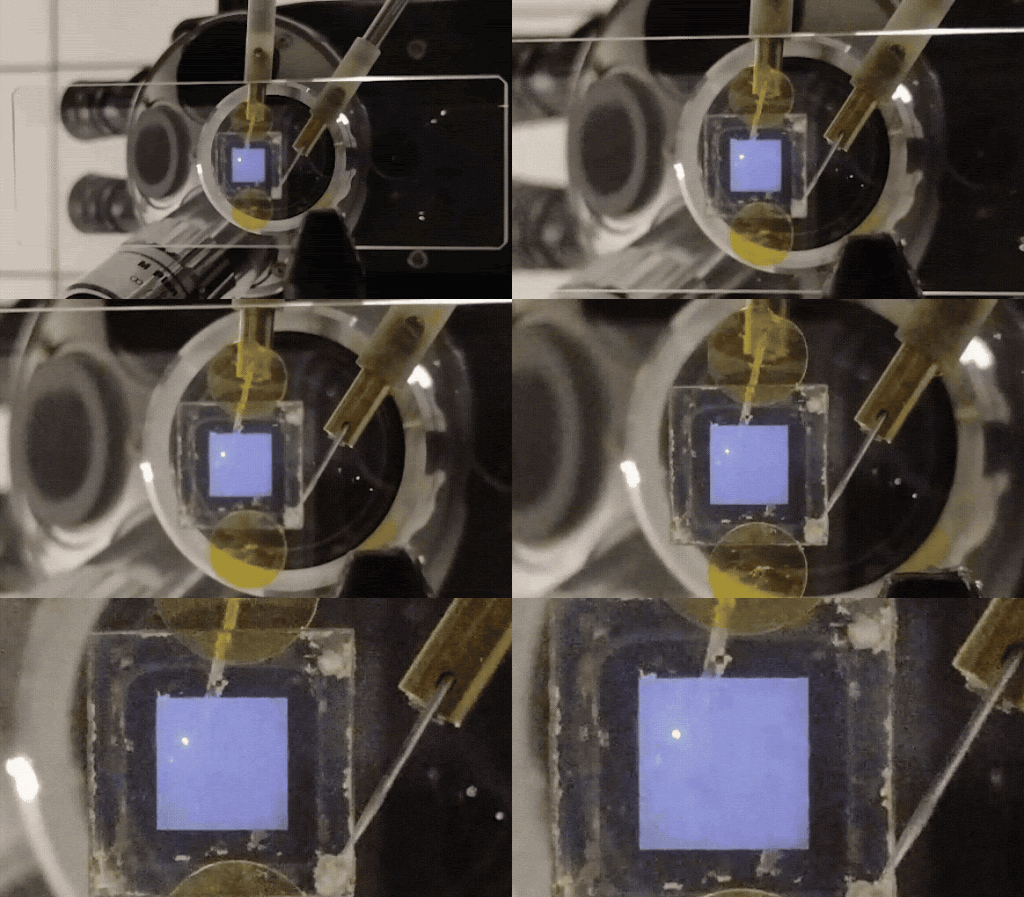
The bright spot of light viewed through this microscope is an NS Nanotech micro-LED, illuminated by over 1,000 submicron-scale nanowires. Our nanowire LEDs will be essential to enabling displays for next-generation AI smart glasses.
“Smart glasses” promise to immerse you in a new world of AI applications.
In the near future, you won’t need to use your thumbs to interact with AI agents on your phone or click a mouse cursor on your computer screen. Instead, you will wear a pair of super-intelligent eyeglasses that immerse you in AI, enabling you to see, hear, and navigate both real and virtual worlds with a flick of your wrist and a nod of your head.
A current generation of AI "smart glasses" hints at this future. AI glasses from Meta, Vuzix, Rokid, XREAL and other manufacturers provide impressive audio and display technologies. They can give you wireless access to your phone to stream Bluetooth audio and record real-time video with tiny speakers and cameras embedded in the eyeglass frames.
They also have embedded displays in lenses that will let you read your emails, send texts, generate immediate captions of conversations, display real-time translations of foreign languages, manage your calendar, and perform dozens of other digital chores. Meta offers a sensor-laden wristband that communicates with the glasses and your phone to navigate your apps with simple hand gestures.
There's just one problem: they're still too big and heavy.

Vuzix Shield smart glasses use advanced waveguide optics and a micro-light engine to provide a bright see-through digital display. But like other smart display glasses, frames accommodating these advanced technologies still are larger than “normal-sized” eyeglasses. (Photo source: Vuzix Corp.)
Unfortunately, all the components required to deliver these amazing AI capabilities are still just a little too big, bulky, and heavy to integrate into a sleek, attractive pair of eyeglass frames. They must include a rechargeable battery, microprocessor, camera, multiple miniature microphones and speakers, and receivers and sensors to communicate with the phone and wrist-band controller. Finally, there’s a microdisplay engine with a waveguide to project images onto the lens.
The most challenging element is the size of the LEDs required to project sharp real-time text and images on the eyeglass display. Today’s displays for AI glasses, tiny as they are, utilize LED technologies that are inherently limited by current fabrication technologies. They are still too large to fit comfortably into a sleek pair of eyeglass frames.
That’s where NS Nanotech's nanowire LED technologies come into play. Our patented process grows nanowire LEDs from the bottom up on standard substrates, rather than etching LED semiconductor material from the top down. These tiny nanowires can be clustered to enable full-color microdisplays that are orders of magnitude smaller than today’s LEDs.

Drawing on exclusive licenses to patents held by the University of Michigan and McGill University in Montreal, we have already demonstrated working submicron-scale nanowire LEDs in our labs and are advancing fabrication techniques that will enable scale-up of manufacturing. Our team of PhD’s in our Montreal R&D center, along with major manufacturing partners, expect to reach important milestones in 2026. So watch this space!
In the meantime, to learn more about our nanowire technologies, visit our website and an in-depth review published by Compound Semiconductor Magazine.


Comments